

This article contains affiliate links. If you purchase through one of these links, Ginger Cat Publishing earns a small commission.
What happens to faith when the future you expected disappears before you have even had the chance to live it?
Sixteen-year-old Jack Simpson returns home after his father’s death expecting grief, but not the complete loss of the life for which he has been prepared. The family fortune has vanished. Lint Hall, the home that represented inheritance, identity and belonging, is no longer his. His education, friendships and expectations were built around a social position that has suddenly ceased to exist.
Jack must now exchange the life of a young gentleman for modest lodgings, careful economy and long hours behind the booking window of Oakhill railway station. There he handles tickets, answers questions, keeps accounts and learns that honest work can be both humbling and honourable. A sixpence engraved with three words becomes his quiet reminder of the path before him: “Work, Wait, Win.”
First published in 1891, Ruth Lamb’s Work, Wait, Win is a Victorian Christian novel about sudden loss, ordinary responsibility and the formation of character. It asks whether faith can remain steady when prayer appears unanswered, whether work retains its dignity when society looks down upon it, and whether winning might mean something deeper than recovering what has been taken away.
When a secure future disappears
Jack’s loss is not only financial. The disappearance of the family estate alters the way other people see him and, for a time, the way he sees himself.
In late-Victorian society, a family home such as Lint Hall represented far more than a valuable building. It carried a sense of continuity between generations. Education, social relationships, marriage prospects and future responsibilities could all be formed around the assumption that the family’s position would remain secure. When the house and fortune were lost, Jack did not simply become poorer. He became uncertain of his place in the world.
That experience gives the novel an emotional reach beyond its nineteenth-century setting. A modern reader may encounter the same disorientation through bereavement, redundancy, illness, financial difficulty, divorce or an unwanted change of role. The practical circumstances differ, but the inward question remains familiar: who am I when the life that confirmed my identity is no longer available to me?
Jack’s struggle is made more convincing because he is neither helpless nor faultless. He is conscientious, generous and determined to behave honourably, but his self-respect sometimes hardens into pride. His wish to remain independent can make kindness difficult to receive. He is capable of mistaken assumptions, private resentment and unnecessary anxiety.
Ruth Lamb allows him to develop gradually. He does not make one courageous decision and immediately become equal to every difficulty. He must get up, turn up, learn unfamiliar duties, accept correction and continue when no one is applauding. His growth takes place through the repeated demands of ordinary life.
This is one of the novel’s most thoughtful qualities. It recognises that a person may understand intellectually that an old life has ended while continuing to judge the new life by standards that no longer fit. The interval between identities can feel like failure, even when something valuable is quietly being formed.
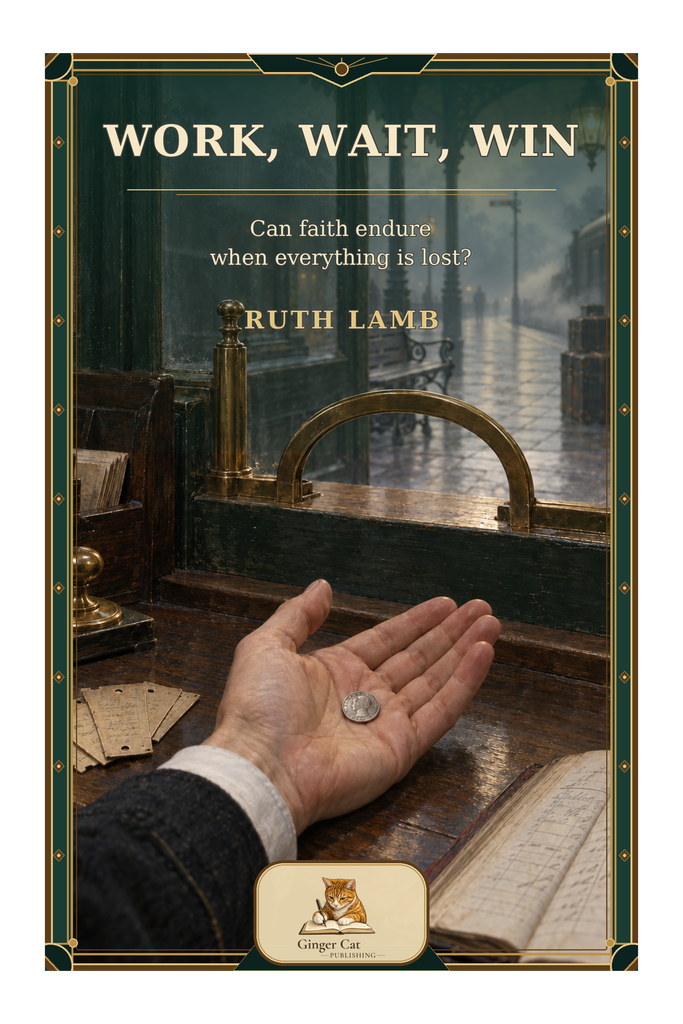
The three words that shape the story
The title appears simple. Each word becomes more demanding when it must be lived.
Work offers Jack something practical to do. He can learn his duties, keep accurate accounts, treat passengers courteously and make himself useful. Work does not immediately restore his position, but it gives shape to days that might otherwise be consumed by grief and humiliation.
Waiting is harder. It offers no definite timetable and no promise that present effort will produce the desired result. Jack must continue without knowing whether his circumstances will improve, whether important relationships will survive his altered position, or whether prayer will be answered in the form he hopes.
Winning is the most difficult word to define. Does it mean recovering wealth and social standing? Receiving the approval of people who have judged him by his circumstances? Regaining what he believed his life would be? Or can a person already have achieved a quieter victory by becoming honest, dependable and faithful before anything outward has been restored?
The novel does not treat its title as a formula. Work does not purchase providence. Waiting does not place God under an obligation. Faithful effort is not a bargain that guarantees prosperity.
Instead, the three words describe a pattern of living within circumstances that cannot be controlled. Do the work that belongs to you. Continue faithfully when the outcome remains hidden. Learn to recognise forms of victory that may not resemble the future you originally imagined.
Honest work and invisible character
Work occupies an unusually honourable place in the novel. Jack’s employment is not merely a temporary inconvenience placed between the opening disaster and a more desirable life. The railway booking office becomes one of the principal settings in which his character is tested and strengthened.
By 1891, the railway was no longer a startling innovation. It had become part of the structure of British life, carrying passengers, letters, food, newspapers and manufactured goods between towns and cities. Stations connected local communities to a national network and brought people of different classes into close, managed contact.
The booking clerk stood at one of the railway’s most visible points. He was expected to know fares, destinations and connections, issue the correct tickets, handle money and balance his accounts. Accuracy mattered. A mistake could cause practical difficulty, financial loss or suspicion about the clerk’s honesty.
For Jack, the booking-office window is therefore both workplace and public stage. He is useful, visible and constrained. People who knew his former position may now encounter him as a railway employee. The young man educated for one sort of future must become a beginner in another, and he must do so where others can watch.
Modern attitudes towards employment are different, but the status attached to work has not disappeared. Job titles, earnings and professional confidence are still used as shorthand for personal worth. Some occupations attract admiration while others remain unnoticed, even when they require patience, skill and responsibility.
Lamb’s novel encourages a more searching view. What might a person become through duties that are necessary but not glamorous? Accuracy, punctuality, restraint and reliability rarely announce themselves dramatically. They are virtues of repetition, formed by doing an ordinary task properly when it would be easier not to care.
The story does not suggest that every hardship is beneficial or that exhausting conditions should be romanticised. Its interest lies in the possibility that useful work can restore direction when life has been disrupted. Becoming useful does not solve every problem, but it can remind a person that altered circumstances have not erased the ability to contribute.
Waiting when heaven seems silent
The middle word of the title may be its most challenging.
Work permits action. Winning suggests an ending. Waiting describes the long space between them, when effort has been made but the result remains beyond reach.
Waiting can appear empty from the outside. In reality, it is often crowded with fear, calculation, disappointment and the temptation to force events. It requires a person to continue living while certainty remains unavailable.
Modern life has made many kinds of waiting shorter. Messages arrive immediately, journeys can be tracked and information can be summoned within moments. When uncertainty cannot be solved by greater speed, better information or another plan, it may feel as though something has gone wrong.
The novel offers a different possibility. Some periods cannot be hurried without damaging what is being formed within them.
Jack’s waiting is never simply passive. It includes work, prayer, restraint, error, correction and the gradual reshaping of his judgement. He must act where action is possible without imagining that action gives him control over every outcome.
For Christian readers, this reaches beyond patience into the nature of faith itself. It is comparatively easy to speak about providence when events are beginning to make sense. It is harder when prayer appears unanswered, unfairness continues and the next step offers no reassurance.
The question beneath Work, Wait, Win is not merely whether faith survives loss. It is what faith becomes when heaven seems silent. Does trust depend upon receiving an immediate explanation, or can it remain when the reason for a season of difficulty is hidden?
Lamb’s answer is expressed through conduct more often than certainty. Faith is visible in honesty, forgiveness, careful speech, faithful work and the refusal to reduce another person to the worst possible interpretation of his behaviour. Belief does not remove grief, pride or uncertainty. It shapes the way those experiences are lived.
This prevents the novel’s Christianity from becoming ornamental. Faith is not added to the story through occasional religious language. It is woven through decisions about money, promises, reputation, loyalty and mercy.
Small sums and difficult choices
Money runs throughout the novel, but not merely as a means of measuring poverty or wealth. It reveals what people value and how they judge one another.
The disappearance of Jack’s fortune changes some relationships immediately. Affection that appeared secure is exposed as conditional. Social approval proves capable of rising and falling with income and position. Yet poverty is not treated as automatically virtuous, just as wealth is not treated as automatically corrupting. Both can reveal generosity, fear, vanity, gratitude, control or distrust.
The novel’s references to shillings, pence and half-crowns would have conveyed proportion naturally to its first readers. A pound contained twenty shillings, while a shilling contained twelve pence. A half-crown was worth two shillings and sixpence. Exact modern conversions can be misleading because the cost and significance of goods have changed so much. The importance of these sums is better understood through the choices they permitted.
For a household living on limited means, a few pence could affect the quality of a meal or the margin remaining after rent, fuel and washing were paid. Clothing needed to last, and a neat appearance mattered because it was often read as evidence of respectability and self-command. Lodgings gave young workers somewhere to live, but did not necessarily provide comfort, privacy or independence.
When Lamb pauses over modest wages, debts or careful accounts, she is not interrupting the story with unnecessary bookkeeping. She is showing the material conditions within which honesty and patience must operate.
It is much easier to praise generosity when there is money to spare. It is much easier to reject a questionable advantage when doing so carries no personal cost. Jack’s principles are tested because small financial decisions matter.
The book also considers the complicated experience of receiving help. Assistance can meet a genuine need while reminding the recipient of lost independence. A giver may believe that a gift is simple, while the person receiving it feels gratitude, relief, embarrassment and resentment at once.
Kindness that ignores dignity can become controlling. Pride that refuses every kindness can leave a person isolated. Between the two lies the difficult art of helping without turning another human being into a project.
Reputation, suspicion and the possibility of change
Alongside its domestic relationships and restrained romance, the novel develops an element of moral suspense. Questions of theft, suspicion and a troubled past enter Jack’s world, requiring him to decide how much can be known from appearances.
Lamb understands how readily fragments of information become complete stories about people. Once suspicion has settled, even innocent behaviour may appear to confirm it. A mistake, accusation or known failure can become the lens through which every later action is interpreted.
The communications world of 1891 was very different from our own, but this tendency has not vanished. Judgements can now circulate more quickly than facts, and a person’s worst moment may remain permanently visible. It can be satisfying to decide that we know what sort of person someone is. Certainty releases us from the harder work of paying attention.
The novel does not ask readers to ignore wrongdoing or abandon wisdom. Instead, it questions whether judgement leaves room for truth, repentance and restoration.
Second chances are easier to approve in principle than to offer when trust involves risk. Forgiveness does not automatically restore access, responsibility or intimacy. Trust may require evidence and time. Yet if every door remains closed until a changed life has already been proved, where can that proof be lived?
This tension gives the story much of its moral interest. Respectability and goodness are not always the same thing. A polished reputation may conceal hardness, while someone marked by the past may be struggling towards honesty.
Lamb’s characters are not divided neatly between the deserving and undeserving. Good motives can be mixed with pride. Sharp speech may conceal affection. A person capable of generosity may also be mistaken or controlling. The novel’s moral direction is clear, but the people travelling towards it remain recognisably untidy.
Love, money and Victorian security
Marriage in late-Victorian fiction cannot always be separated neatly from questions of property and security. Love existed within a world in which family position, income and inheritance could greatly affect the choices available to both men and women.
The Married Women’s Property Acts of 1870 and 1882 increased married women’s ability to control earnings and own property. The 1882 Act treated a married woman as capable of holding and disposing of property in her own right. Legal reform, however, did not instantly remove economic dependence or alter every social expectation.
Marriage could offer security, change a family’s position or expose differences in wealth. These realities did not make affection insincere, but they meant that romantic choices carried practical consequences that modern readers may not immediately feel.
Money has already changed the way Jack is treated. It has revealed which affections can survive altered circumstances and which were partly tied to advantage. As the novel develops, Lamb continues to explore whether love can remain free from calculation and whether two people can value one another without allowing wealth to decide who possesses greater worth.
The romantic strand is gentle rather than dominant. It grows within the larger questions of loyalty, patience and character. Affection is tested not by extravagant declarations but by absence, uncertainty, family pressure and changes of fortune.
Ruth Lamb and the world of Christian family fiction
Ruth Lamb was born Ruth Buck in Grimsby, Lincolnshire, in 1829. She was the daughter of Thomas Buck, a grocer, and his wife, also named Ruth. She later married Joseph Lamb of Manchester, and they had three children. She died in Lancashire in 1916, having lived through almost all of Queen Victoria’s reign and into the reign of George V.
The surviving facts provide an outline rather than a full portrait. No substantial modern biography appears to have been devoted to her, and readily available records do not preserve a large collection of letters, diaries or interviews. It would be tempting to fill those quiet spaces with guesses, but her books provide clearer evidence of her working life.
Lamb published steadily for approximately four decades, writing particularly for children, families and the Christian reading market. The bibliographical database At the Circulating Library records thirty-nine works of fiction published between 1861 and 1900.
Her publishers included W. and R. Chambers, the Society for Promoting Christian Knowledge, the Religious Tract Society, Hodder and Stoughton, Thomas Nelson and James Nisbet. These organisations helped carry accessible and morally serious reading into homes, schools, Sunday schools and lending libraries.
This was a substantial reading culture, although later literary histories often treated it as secondary to the work of novelists who entered the established canon. Books written for Christian households and younger readers might be read repeatedly, presented as prizes and passed between families, yet gradually disappear as tastes changed.
Lamb’s titles reveal her continuing interests: work, mistakes, character, marriage, service, social position and the possibility of restoration. She wrote about clerks, servants, children, wives, workers, offenders and neighbours. Moral choices were placed within homes, workplaces and communities rather than discussed only as abstract religious ideas.
Her Christianity was practical. Belief became visible in the keeping of promises, the use of money, the willingness to work, the refusal to condemn too quickly and the ability to continue when immediate circumstances offered little encouragement.
Work, Wait, Win appeared in 1891, thirty years after Lamb’s earliest recorded fiction. It was therefore not the uncertain beginning of a new author, but the work of an experienced storyteller who had spent decades thinking about the formation of character.
That experience can be felt in the novel’s mixture of domestic observation, gentle humour, social reversal, romance and suspense. Lamb is morally serious, but she understands that people rarely do the right thing for perfectly uncomplicated reasons. Pride can hide inside duty. Affection can be disguised by awkwardness. Respectability can exist without mercy.
What does it mean to win?
The final word of the title might suggest triumph, but Lamb’s idea of winning is quieter than conquest.
A life may not return to its original shape. Public opinion may lag behind truth. Material improvement may matter without becoming the complete measure of success. The deeper victory concerns what has been preserved or transformed within a person while the outcome remained uncertain.
This raises a question that feels particularly modern: whose scoreboard are we using?
Success is often narrated through income, visibility, influence, recovery or the appearance of having moved forward. Such measures are not meaningless, but they reveal only part of a life. Someone may appear restored while becoming bitter. Another person may appear unsuccessful while growing in courage, honesty and compassion.
The novel invites us to imagine a form of winning that may first be recognised in character and only later, if ever, in circumstance.
That idea must be handled with care. Spiritual victory should never be used to minimise material suffering or to ask vulnerable people to endure conditions that ought to be changed. Patience can be courageous, but it should not be demanded by people who benefit from someone else’s powerlessness.
Lamb’s vision is most useful when it strengthens compassion. The dignity of character does not make poverty unimportant. The value of patience does not excuse injustice. Faithfulness matters within hardship, but hardship remains real.
A Victorian novel for modern readers
Some readers will find the novel’s moral confidence comforting. Others may find its direct references to faith and providence unfamiliar. Its pace also belongs to an age more willing to allow important changes to accumulate through recurring duties, conversations, misunderstandings and gradually altered relationships.
That slower rhythm is part of the book’s invitation. The narrative asks us to notice development rather than hurry towards resolution. It allows characters time to surprise us and gives mixed motives room to emerge.
Modern readers do not need to adopt every Victorian assumption in order to listen seriously to the questions the story asks. Nor do we need to assume that our own age has resolved the problems it explores. We still judge people by position and income. We still struggle to distinguish self-respect from pride. We still find it easier to approve of forgiveness in theory than to risk offering someone a genuine second chance.
Above all, we still know what it means to wait.
Work, Wait, Win does not promise that labour and patience will allow us to control the future. Its title is better understood as an invitation to faithfulness: undertake the work before you, wait without assuming that delay means abandonment, and remain open to a victory that may arrive in a different form from the one you expected.
The Ginger Cat Publishing edition preserves the novel’s original period character while providing a new introduction, historical background, an account of Ruth Lamb’s life and writing, a reflection for modern readers and points to ponder. These additions are intended to accompany the story without telling readers what they must conclude.
Ruth Lamb’s world is distant in its social arrangements, currency and railway routines. Its deeper concerns remain close. What gives work dignity? How does money affect love and friendship? Can people outgrow the stories told about them? What does faith look like when heaven seems silent?
And when circumstances give us no immediate assurance of winning, how shall we work and wait?
Sources Consulted
- Ruth Lamb, Work, Wait, Win, Project Gutenberg ebook no. 79593: https://www.gutenberg.org/ebooks/79593
- Troy J. Bassett, “Ruth Lamb”, At the Circulating Library: A Database of Victorian Fiction, 1837–1901: https://www.victorianresearch.org/atcl/show_author.php?aid=3381
- Rugby School, “History and Heritage”: https://www.rugbyschool.co.uk/about/history-heritage
- Married Women’s Property Act 1882, enacted text: https://www.legislation.gov.uk/ukpga/Vict/45-46/75/enacted
- The National Archives, “Victorian Prison”: https://www.nationalarchives.gov.uk/education/resources/victorian-prison/
- Science Museum, “Stephenson’s Rocket, Rainhill and the Rise of the Locomotive”: https://www.sciencemuseum.org.uk/objects-and-stories/stephensons-rocket-rainhill-and-rise-locomotive