
This article contains affiliate links. If you purchase through one of these links, Ginger Cat Publishing earns a small commission.
We usually make our promises when we mean them most.
We promise to be patient, to control our temper, to shoulder a new responsibility or to resist the influence of someone we know is leading us in the wrong direction. At the moment of promising, our intentions are entirely sincere. Then ordinary life resumes, bringing tiredness, provocation, disappointment and all the familiar pressures that reveal the distance between what we intend to do and what we are able to do.
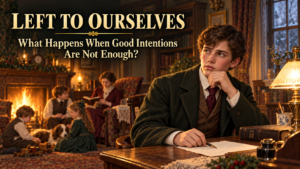
This is the struggle at the heart of Left to Ourselves; or, John Headley’s Promise by Catharine Shaw.
First published in London in 1884, the novel follows five brothers and sisters whose parents must leave them for approximately three months. Their father has business in America, while their mother hopes to visit her elderly and ailing mother after twenty years of separation. The children will not be entirely without adult help, but the familiar order of their household is about to change.
Agnes, the eldest daughter, accepts the principal responsibility for the home. Sixteen-year-old John makes a sincere promise to control his strong temper. Hugh must begin making choices beyond the immediate protection of his parents, while Alice and Minnie bring their own mixture of affection, resistance, generosity and childish mischief.
At first, being left in one another’s care may sound almost like freedom. Yet it soon becomes something much more searching. Without their parents beside them, what will govern the children’s choices? When their good intentions are tested, will determination be enough?

A Promise Made in Earnest
John Headley is not careless about his faults. He knows that disagreements with his brother Hugh can quickly become heated, and he genuinely wants to change. Before his parents depart, he promises Agnes that when an argument begins, he will either leave the room or remain silent.
It is a practical promise, apparently simple enough to keep. It also reflects something attractive in John’s character. He wants to be dependable. He wants to govern himself and become the sort of brother his family can trust.
The trouble is that John’s strong will is both part of the solution and part of the problem.
Determination may restrain him for a time, but it cannot by itself remove his pride, impatience or desire to be proved right. Even when his concern about Hugh is justified, the manner in which he expresses it may still wound or provoke. He must learn that saying something true does not automatically make every way of saying it right.
Catharine Shaw does not treat John’s promise as foolish or meaningless. She asks a more difficult question: what is that promise resting upon?
John initially approaches goodness as something he should be able to produce through effort. If he resolves firmly enough, watches himself closely enough and tries hard enough, surely he can become the person he ought to be.
His failures gradually reveal that Christian obedience cannot be reduced to willpower.
The Burden of Being the Responsible One
John’s struggle is reflected differently in Agnes.
Agnes has been trusted with the care of the household, and she accepts the responsibility lovingly. Yet loving her brothers and sisters does not give her all her mother’s experience. Servants, lessons, disagreements, domestic arrangements and the emotional needs of the younger children begin pressing upon her at once.
She tries to meet each demand well. Before long, however, responsibility begins turning into self-reliance. Agnes does not merely want to do her best. She begins to feel that she must somehow keep everything under control.
That temptation remains strikingly recognisable.
There is a difference between accepting responsibility and believing that everything depends upon us. The first may be an act of loving service. The second can quietly become a burden we were never intended to carry alone.
Agnes’s exhaustion is not caused by indifference. It grows from caring deeply, trying earnestly and believing that she ought to manage better. Her difficulty is therefore easy to overlook. From the outside, she appears capable and devoted. Inside, she is measuring herself against every frustration and failure.
Through the counsel of Aunt Phyllis, Agnes begins to see that constantly examining her own ability will not give her the strength she needs. She must turn her attention away from herself and towards Christ.
The circumstances do not instantly become easier. What changes is the source from which she meets them.
“Lord, What Wilt Thou Have Me to Do?”
Before leaving, the Headley parents give their children one question to guide them:
“Lord, what wilt Thou have me to do?”
The words are displayed where the family can see them. They become far more than a Victorian household motto. They gather the novel’s spiritual argument into a single question.
It is tempting to decide what we want to do and then ask God to approve it. This question reverses that order. It requires the children to pause before acting and to remain willing to receive an answer that may challenge their pride or inconvenience their plans.
For John, it means that governing his temper is not simply a personal improvement project. He must learn to respond to his brother as Christ would have him respond.
For Agnes, it means recognising that faithfulness does not require her to possess endless strength.
For Hugh, it means deciding whether loyalty to a companion should outweigh the convictions he has been taught at home.
The words also answer the book’s title. The children may have been left without the immediate presence of their parents, but they have not truly been abandoned to themselves. God’s guidance remains available, although accepting that guidance demands humility, prayer and obedience.
Faith Explained Through Colour
One of the novel’s most distinctive features is its use of the Wordless Book.
This simple evangelistic device uses coloured pages rather than printed words. In the four-colour form reflected in Shaw’s story, black represents sin, red represents Christ’s blood and saving work, white represents cleansing and righteousness, and gold represents everlasting glory.
Agnes develops these colours into an allegorical story about two travellers who ignore their guidebook, enter a dark cavern and find themselves trapped by a creature called Sin. They cannot free themselves, however earnestly they struggle. Their rescue must come from the King’s Son.
This allegory establishes the Christian foundation beneath the family story. The children’s difficulties may appear small beside the dramatic imagery of captivity and rescue, but the underlying lesson is the same. Human effort cannot accomplish what only Christ can do.
Later, another allegory uses lamps and golden oil to illustrate dependence upon the Holy Spirit. Together, these passages make Left to Ourselves much more than a generally wholesome Victorian story. Its Christianity is not decorative or confined to occasional religious remarks. It shapes the novel’s understanding of human nature, change, failure and grace.
The Tests Hidden Inside Ordinary Life
There is no single catastrophe at the centre of Left to Ourselves. Instead, the Headley children are tested through ordinary domestic life.
There are lessons to supervise, servants to manage and charitable parcels to distribute. Christmas puddings travel in unintended directions. A bedroom reorganisation produces disorder rather than improvement. Minnie turns matchboxes and tiny china dolls into gifts for children in hospital, only to discover that performing a kind act does not prevent her from behaving crossly towards someone at home.
These smaller incidents give the novel much of its warmth and gentle humour. They also allow Shaw to make one of her most enduring observations: character is often revealed more clearly in repeated, commonplace choices than in grand declarations.
It may be easier to imagine making a heroic sacrifice than to answer gently when tired. It may be more satisfying to undertake a recognised charitable project than to show patience towards an irritating brother or sister. We may want to serve God in some visible way while overlooking the ordinary work already before us.
The children gradually learn that Christian service cannot be separated from their treatment of one another. Love is expressed through apologies, restraint, practical help, honesty and the willingness to begin again after failure.
Hugh and the Courage to Stand Apart
Hugh faces a different test when he spends time with an unsuitable school companion, Tom Radnor.
He is persuaded to drink beer despite knowing that his father has taught the children to abstain from alcohol. For a Victorian reader, this episode would have carried the additional weight of the nineteenth-century temperance movement. Yet its deeper conflict remains immediately understandable.
Hugh knows what he believes, but he lacks the courage to appear different.
Peer pressure rarely begins by asking someone to abandon everything they value. More often, it presents one small compromise and makes resistance feel awkward, childish or disloyal. Hugh’s failure is therefore not simply about a drink. It concerns the moment when acceptance by a companion matters more to him than acting upon his convictions.
John’s response also becomes part of the test. He is right to be concerned, but even rightful concern must be governed by humility and love. Both brothers have something to learn, and neither can help the other merely by proving himself correct.
Failure Is Not the End of the Promise
A weaker story might divide the children neatly into those who behave well and those who behave badly. Shaw’s characters are more recognisable than that.
They fail while trying to do right. They mix generosity with impatience, responsibility with pride, concern with interference and conviction with fear. Their mistakes do not prove that their earlier intentions were false. They reveal that good intentions cannot sustain themselves.
This is where the novel’s gentleness matters.
John does not discover that promises are worthless. He discovers that he cannot keep them through his own strength alone. Agnes does not learn to abandon responsibility. She learns to carry it in dependence upon Christ. Hugh’s failure does not place him beyond forgiveness. It gives him an opportunity to confess, accept correction and grow in moral courage.
Grace does not make their choices unimportant. It allows failure to become a place of repentance and renewed obedience rather than the final verdict upon them.
Why Left to Ourselves Still Matters
The Headley family inhabits a recognisably Victorian world of servants, schoolroom lessons, temperance convictions, transatlantic telegrams and carefully prepared Christmas charities. Yet the emotional and spiritual pressures within their home have not disappeared.
Many readers will recognise Agnes’s belief that a responsible person should be able to keep everything together. Others may recognise John’s frustration at repeatedly failing in an area where he sincerely wants to change. Hugh’s struggle between conviction and acceptance remains familiar to every generation.
The novel also understands that family life provides a particularly honest test of character. Those closest to us see the difference between our declared principles and our daily conduct. They encounter us when we are tired, irritated, worried or disappointed. It is often at home that our good intentions meet their most persistent examination.
Left to Ourselves does not offer effortless answers. Its characters must apologise, accept help, resist pressure, reconsider their motives and practise obedience through ordinary work. What it offers is something more hopeful than confidence in human determination.
It reminds us that discovering our weakness need not lead to despair. It may instead teach us where our strength was always meant to be found.
A Recovered Christian Family Story
Ginger Cat Publishing’s edition of Left to Ourselves; or, John Headley’s Promise restores Catharine Shaw’s warm and spiritually searching family story for modern readers.
Alongside the carefully prepared original text, the edition includes an introduction, historical background, information about the author’s known publishing record, guidance for modern readers and reflective Points to Ponder.
If you enjoy forgotten Christian fiction in which faith is worked out through family relationships, moral choices and the ordinary demands of daily life, discover Left to Ourselves on Amazon.
Because sincere promises matter. Yet when good intentions are not enough, we need not conclude that we have truly been left to ourselves.